

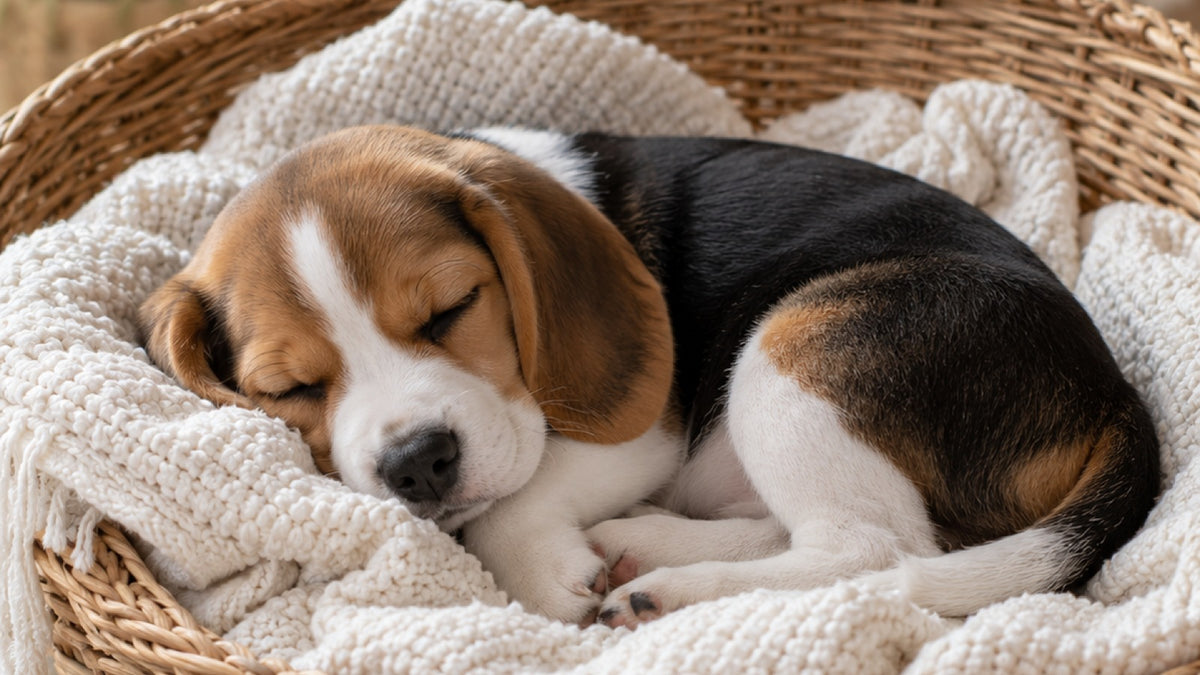
Eighteen to twenty hours of sleep a day is normal for a puppy. It sounds a lot, but it is exactly what a growing brain and body need. Keeping your puppy awake because the number seems excessive usually creates the restlessness, nipping and constant wriggling you wanted to prevent. In a puppy, lack of sleep rarely looks like tiredness. It looks like irritability, overexcited biting and a dog who cannot settle, however much they have already done that day.
Das Video dazu
Mit Klick lädst du das Video von YouTube. Dabei werden Daten an YouTube (Google) übertragen. Datenschutz
18 to 20 hours: why it is no misprint
In the first months of life, a puppy is building practically their entire nervous system. New sights, smells and sounds all need processing and storing, much of which happens during sleep. A puppy who sleeps little therefore learns less. They may look alert and interested but retain experiences less well than a rested puppy.
For comparison, an adult dog usually manages with twelve to fourteen hours. A puppy under twelve weeks sleeps in short spells throughout the day, usually no longer than one to two hours at a time, with perhaps twenty to forty minutes awake and active between them. This rhythm reflects the normal workings of a young brain rather than illness. Longer, continuous sleep periods usually settle in from around four to six months, rather like a baby gradually learning to sleep through.
A typical day therefore consists of many short cycles rather than one long waking period with a midday break: wake, toilet, briefly eat or play, sleep again. Between six and ten such cycles is normal on an ordinary day. Trying to squeeze this rhythm into one morning walk and a quiet afternoon works against your puppy’s biology.
Recognising overtiredness
Owners rarely keep puppies awake deliberately. The problem is that an overtired puppy does not look tired. An overtired toddler whines and rubs their eyes. An overtired puppy gets wound up: racing around the home, tugging trouser legs, biting harder than usual and becoming almost impossible to calm. Many owners respond with more activity because the dog clearly has energy, and the spiral continues.
Busy situations particularly invite this misunderstanding: visitors passing the puppy around, a first training class with many unfamiliar dogs, or children repeatedly waking the puppy as soon as they lie down. None is inherently wrong. Problems arise when they pile up without real rest between them.
| What you notice | What it often means |
|---|---|
| Sudden wild running without an obvious reason | Overtiredness rather than exuberance |
| Harder biting than usual, tugging at clothes | Loss of control through exhaustion |
| Almost impossible to distract or calm | The nervous system is overstimulated |
| Red, slightly irritated eyes, yawning during play | A direct sign of tiredness, often missed |
If two or more apply, another game or walk will not help. Your puppy needs to rest now, even if they object loudly in the moment.
The five-minute rule for walks
A simple rule of thumb helps keep waking and active periods appropriate from the start: five minutes of walking per month of age, twice daily. For a ten-week-old puppy, that means roughly two outings of ten to fifteen minutes, rather than hours in the woods. There are two reasons. Physically, growth plates around the joints are still open, and long distances or lots of stairs put unnecessary strain on them. Mentally, a calm ten-minute walk with a few new impressions already fills a young brain’s programme.
Build a rest period into the routine after every walk, game and visit as a planned part of the day. Establish this from the beginning and you will not later have to work hard at teaching that quiet moments are allowed too.

Practise settling
Most puppies do not settle by themselves while things are happening at home. A common mistake is expecting a puppy to sleep amidst a busy living room, then wondering why they startle awake every few minutes. Rest needs a genuinely quiet place, rather than simply a corner with a blanket. It is worth teaching settling just like sit or stay, with a fixed place and clear routine:
- Set up a retreat, such as a crate or blanket in a quiet spot, away from the main thoroughfare
- After food, play or visitors, guide your puppy there instead of waiting for them to collapse
- Stay nearby at first, sit quietly and give no cues; simply be present
- Gradually extend the time there, starting with a few minutes, always before your puppy is completely exhausted
- Become quieter yourself: dimmer light, a softer voice, no excited talking just before rest
Remember: a retreat is not a punishment area. Your puppy should associate it with relaxation rather than being shut away. For setting up the night-time sleeping place and what usually happens in the first nights, read Puppy will not sleep: what really helps on the first night.
The link with biting and restlessness
Much of what owners describe as a biting problem turns out to be a tiredness problem. A rested puppy still bites, usually playfully and in a manageable way. An overtired puppy bites harder and more often, and is harder to redirect because impulse control is the first thing to weaken as energy falls. Before working on biting, ask whether your puppy has rested at all in the past few hours. For the full four-stage process of teaching bite inhibition, read Puppy biting: teaching bite inhibition.
For where sleep and rest fit into the first weeks alongside toilet training, socialisation and the first cues, see the first 30 days with a puppy. To explore rest and impulse control beyond puppyhood, continue with “Welpenerziehung & Junghundtraining” (book in German).
Find all the portraits that look as good on a quiet wall as in a hallway among our dog portraits.
This article does not replace veterinary advice. If your puppy sleeps noticeably more or less than described here, eats poorly or seems listless, consult your vet rather than heading to another training session.
The complete starter pack, free
The essentials for the first thirty days on 58 printable pages: an honest shopping list, the first 72 hours hour by hour, a 4-week plan, socialisation bingo with 50 experiences and an emergency page for the fridge.
The first 30 days: download free here
See your puppy’s age in human years with our dog age calculator.
Further reading
- The socialisation period: why “as much as possible” is poor advice: how much activity a young brain can really handle
- Puppy training: the 5 rules that really work: training principles for the waking hours
- Puppy checklist: essential supplies and the first 3 days: what should be at home before the first nap
Source: American Kennel Club, "Puppy Sleep: How Much Do Puppies Need?". Accessed on 29.09.2026.
The links to our books are affiliate links. Buying through them supports us at no extra cost to you.


