

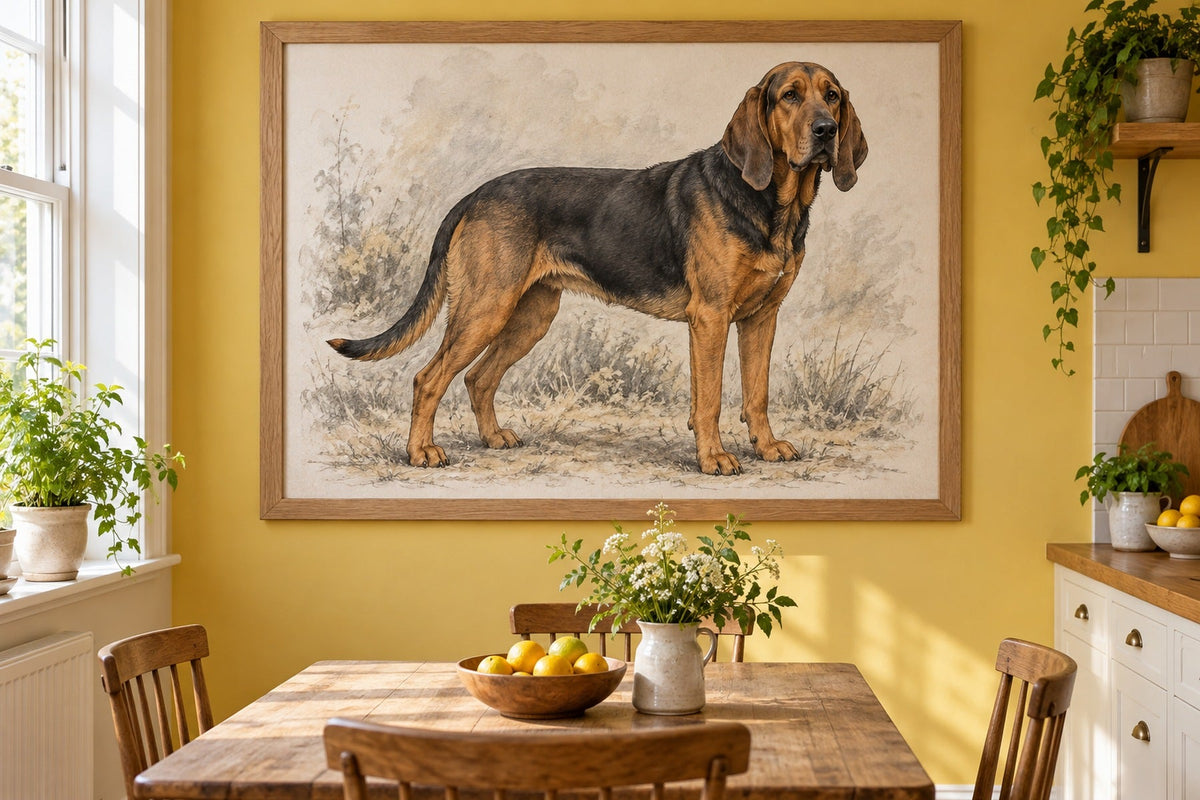
The breed is called Ogar in Polish, and nobody knows for certain where the word comes from. The FCI standard offers three interpretations: yellow-brown like its coat, giving voice like its cry on a trail, or derived from a Czech word for a pointing dog.
| FCI | Group 6 (Scent hounds and related breeds), Section 1.1 Large Hounds, Standard No. 52, with working trial |
|---|---|
| Country of origin | Poland |
| Height at the withers | Males 56 to 65 cm, females 55 to 60 cm |
| Weight | No numerical weight specified in the FCI standard; it should be proportionate to height at the withers and build |
| Life expectancy | No reliable study figure found (N/A) |
| Coat | Short and smooth on head, muzzle, ears and legs; medium-length, thick and harsh elsewhere; dense, soft undercoat |
| Colours according to the standard | Black or dark-grey saddle with reddish-brown shading from dark yellow to mahogany, ears always darker reddish brown; white blaze, chest patch, white on legs or toes and tail tip permitted |
From the chronicles to a fresh start in 1959
According to the standard, the 11th-century chronicles of Gallus Anonymus already describe hunting with dogs, and Ogar hounds were bred specifically for royal hunting in the 14th century. After the Second World War, most of the population lay beyond the new borders. In 1959, Colonel Piotr Kartawik brought four dogs from what is now Belarus and established a kennel; in 1966, the FCI adopted the standard as No. 52.
Built for stamina
The standard requires a muscular, heavy scent hound built for endurance rather than speed. This suits the fairly heavy head, thick hanging upper lip, forehead wrinkles and folded dewlap. It moves at a slow trot and hunts at a gallop that is not particularly fast. Today in Poland, it is used mainly for wild boar and fox, since hare hunting with dogs is prohibited there except in the mountains.
Vocal on a trail, agreeable at home
Like every scent hound, it follows fresh game trails with loud barking, males having deeper voices than females. The standard’s description away from hunting is remarkable: an excellent family dog, easy to keep, submissive to its people and suspicious of strangers. Its passion for hunting still needs an outlet.
What a small founding population means
A Polish pedigree analysis assessed 247 litters from 105 kennels between 1960 and 2004. The population traced back to just 19 founders, four dominating the gene pool, with inbreeding coefficients ranging from 7,7 to 37 per cent depending on birth year (Głażewska 2008). The author links this to deteriorating population health. We found no breed-specific disease studies or lifespan figure. Ask about the litter’s inbreeding coefficient, hip results and ages reached by earlier generations. Because the standard permits somewhat drooping lower eyelids in older dogs, regular veterinary eye checks are important.
Care: ears, lips and folds
Brush the harsh, medium-length coat and dense undercoat once a week. The hanging ears, lip corners and neck folds need more attention, as moisture lingers there after wet days.
Who the hound suits
Hunters seeking a dog that gives voice on the trail of wild boar or fox, and experienced owners with plenty of time outdoors who put its nose to work daily.
When to keep looking
No woodland within reach, little time or neighbours who hear everything: a patient family dog soon becomes a frustrated hunter, and no scent hound deserves that.

Find out whether a heavy scent hound with a deep voice suits you in the breed quiz, or explore more thoroughly in our book “Welcher Hund passt WIRKLICH zu dir?” (book in German). For starting life with a puppy, there is the free Puppy Starter Pack. For Polish Hound owners, explore the magazine-cover canvas and the digital artwork for instant download.
Further reading
- Weimaraner: the beautiful hunting dog that never clocks off
- Older dog, new rules: giving your senior their best years
- Calculating your dog’s food portions: how much your dog really needs
Sources, accessed on 20.10.2026: FCI-Standard Nr. 52 Ogar Polski (Polnische Bracke) (fci.be, German version dated 19.01.2017, English version dated 27.05.2015, valid original standard dated 03.11.2014); Głażewska I, Genetic diversity in Polish hounds estimated by pedigree analysis, Livestock Science 2008; McMillan KM et al., Longevity of companion dog breeds: those at risk from early death, Scientific Reports 2024 (Rasse aufgeführt, nicht ausgewertet).
The links to our books are affiliate links. Buying through them supports us at no extra cost to you.


