

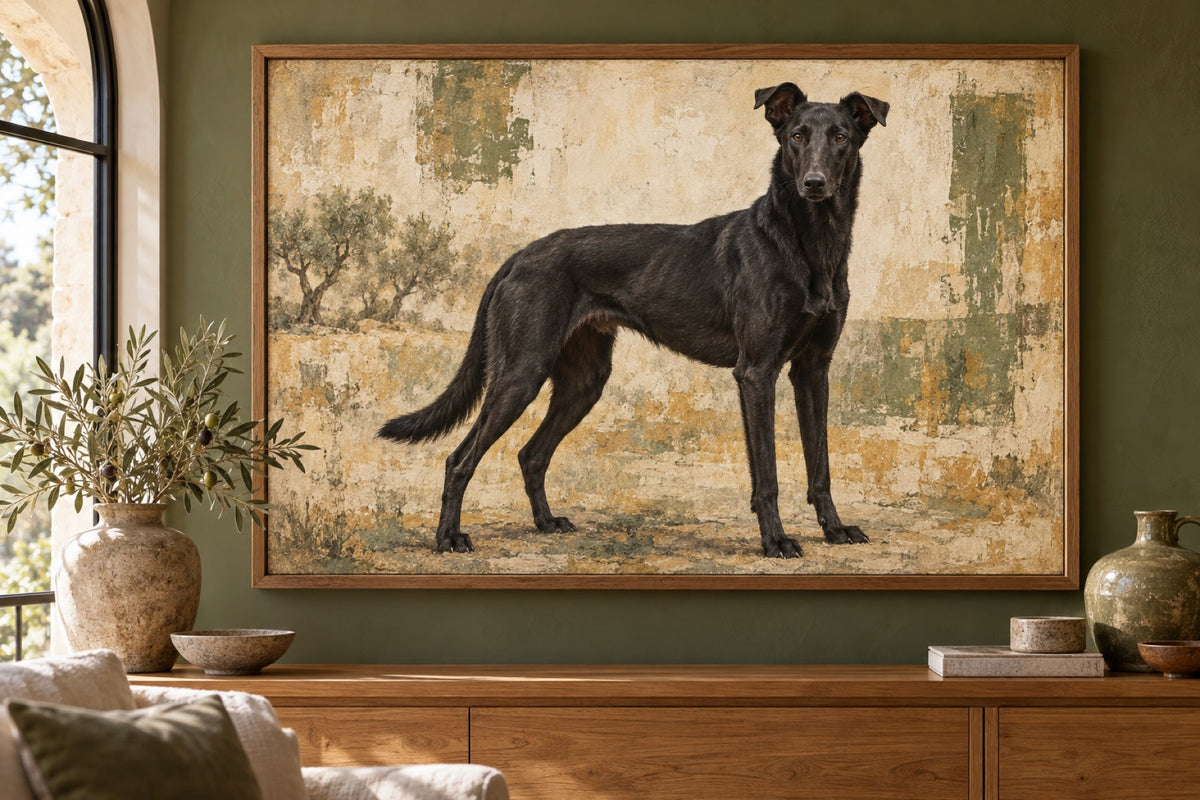
Black, exclusively. The FCI standard even distinguishes three shades in the Majorca Shepherd Dog (Ca de Bestiar): jet, ordinary and pitch black, valuing flawless jet black highest. Add an expression the text calls enigmatic: intelligent and sad at once, with a trace of mistrust.
| FCI | Group 1 (Sheepdogs and Cattledogs), Section 1 Sheepdogs, Standard No. 321 Ca de Bestiar, Perro de Pastor Mallorquín (Mallorca-Schäferhund), without working trial |
|---|---|
| Country of origin | Spain (Balearic Islands) |
| Size (height at the withers) | Males 66 to 73 cm, females 62 to 68 cm; 1 cm deviation accepted |
| Weight | average weight approximately 40 kg; adult males under 30 or over 50 kg and females under 25 or over 54 kg are disqualified |
| Life expectancy | no reliable study figure found (N/A) |
| Coat | two varieties: short-haired, close-fitting, 1,5 to 3 cm on back with very fine undercoat; long-haired (Ca cabrer), slightly wavy, a little over 7 cm in winter |
| Colours in the standard | black only, in jet, ordinary and pitch black; white only as a small marking on chest and neck; white toes heavily penalised |
Herding, guarding and protecting
The standard lists its work as herding, guarding and protection. The breed’s origins remain unclear; the first descriptions of its build date from the 19th century (Alanzor Puente et al. 2020). The FCI definitively recognised it on 26.05.1982. Among Balearic breeds, its closest genetic relative is the Majorca Mastiff, the Ca de Bou (Alanzor Puente et al. 2024). Another dog from the islands is the Ibizan Hound.
One master, and only one
The standard speaks of great nobility: the Ca de Bestiar recognises only one master and dislikes strangers approaching. It is intelligent, biddable, affectionate, extremely shy when young, loyal unto death, brave and quarrelsome. It needs an experienced, calm hand, planned early encounters with people and dogs and a home without constant visitors.
Large, fast and happiest galloping
It gallops while working; the standard calls this its preferred gait. It needs plenty of space, securely fenced land and daily tasks for its guarding instinct. Some German states impose specific duties for large, heavy dogs regardless of breed; ask the state or municipality before buying.
Short hair and Ca cabrer
The common short-haired variety needs weekly brushing. The long-haired variety is called Ca cabrer, dog with goat hair. Its coat grows longest in winter and needs more frequent brushing then.
Dewclaws and a small gene pool
The 1982 standard calls for naturally occurring dewclaws to be removed. However, Germany’s Animal Welfare Act permits amputations only for veterinary indications. A stud-book analysis found 53 founders and an average of 16 births yearly, with a maximum of 37. Measured inbreeding was low, but pedigrees averaged only 1,04 complete generations, making that value less informative (Alanzor Puente et al. 2020). Reliable lifespan and disease studies are lacking. Ask for both parents’ hip and elbow X-ray results.
Who will be happy with this dog
Experienced owners with a house, large grounds and a quiet life, seeking a serious guardian and willing to commit to long, thorough socialisation.
Who should choose another breed
First-time owners, families with frequent visitors and anyone seeking a dog that welcomes strangers warmly.

Before such a serious guardian moves in, try the breed quiz; for more detail, see the book “Welcher Hund passt WIRKLICH zu dir?” (book in German). For the early days with a puppy, we have the free Puppy Starter Pack. A black dog makes especially striking artwork, for example on a magazine cover on canvas or in our other dog portraits from your photo.
Further reading
- German Shepherd: why so many end up in shelters
- The socialisation period: why “as much as possible” is the wrong advice
- The first 30 days with a puppy: a plan for weeks 1 to 4
Sources, accessed on 20.10.2026: FCI-Standard Nr. 321 Ca de Bestiar, Perro de Pastor Mallorquín (Mallorca-Schäferhund) (fci.be, German version dated 30.08.2002; no English version published); FCI breed page No. 321 (fci.be); Tierschutzgesetz § 6 (gesetze-im-internet.de); Alanzor Puente JM et al., Does Functionality Condition the Population Structure and Genetic Diversity of Endangered Dog Breeds under Island Territorial Isolation?, Animals 2020; Alanzor Puente JM et al., Integrated Discriminant Evaluation of Molecular Genetic Markers and Genetic Diversity Parameters of Endangered Balearic Dog Breeds, International Journal of Molecular Sciences 2024; McMillan KM et al., Scientific Reports 2024 (breed not analysed).
The links to our books are affiliate links. Buying through them supports us at no extra cost to you.


