

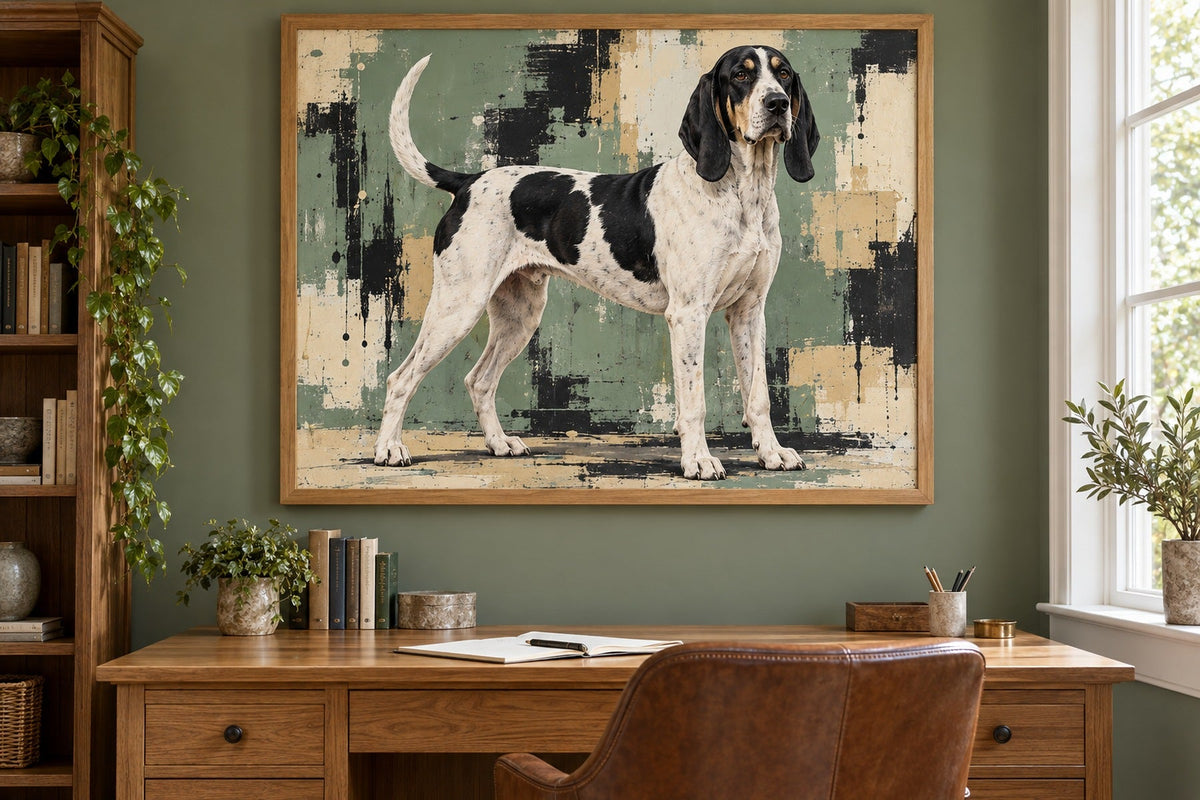
Around 2000 dogs, about 200 puppies a year and packs of roughly 20: the FCI standard itself gives these figures. In theory, the whole breed fits into a hundred packs. The Great Anglo-French White and Black Hound (Grand Anglo-Français Blanc et Noir) still works in packs today, hunting roe deer and red deer.
| FCI | Group 6 (Scent hounds and related breeds), Section 1.1 Large-sized scent hounds, Standard No. 323, with working trial |
|---|---|
| Country of origin | France |
| Size (height at the withers) | Males 65 to 72 cm, females 62 to 68 cm, each plus or minus 1 cm |
| Weight | not specified in the FCI standard |
| Life expectancy | no reliable study figure found (N/A) |
| Coat | short, fairly strong and dense |
| Colours in the standard | white and black with a black mantle or patches, black or blue ticking possible, tan ticking on legs possible, pale tan markings at eyes, cheeks, ears and tail root; tricolour disqualifies |
From Bâtard Anglo-Saintongeois to a breed of its own
According to the standard, its ancestor was the Bâtard Anglo-Saintongeois, developed in the mid-19th century by crossing Saintongeois and English Foxhound. The text still links its strong bone to the Gascon Saintongeois, while it shares English ancestry with the English Foxhound. The FCI recognised the breed in 1983. The Club du Chien d'Ordre wrote the historical summary in the standard in 2007; the German translation dates from 2016.
Sociable and fond of people
Unlike the Tricolore standard, this one addresses temperament: a very sociable dog that likes being near people and is easy to keep in kennels. Its strength is pursuing red deer and roe deer in damp, densely overgrown terrain. Friendliness indoors and hunting drive outdoors coexist; you need a plan for both.
Black on white, with pale tan
White and black are required, as a mantle or patches. Pale tan markings still belong: one spot above each eye, markings on cheeks, beneath ears and at the tail root. A deer mark appears fairly often on the thigh. A tricolour dog is disqualified; that colour belongs to the Great Anglo-French Tricolour Hound (Grand Anglo-Français Tricolore). Black on the cheeks extending to the lips is a serious fault.
Built for wet ground and thickets
Strong, resilient and robust, with thick, large, fairly round feet. Long feet, fragile limbs and severe alignment faults lead to disqualification. The preferred gait is a soft, ground-covering gallop. For you, this means long daily distances, tracking and a securely fenced garden. The short, strong coat needs little more than a grooming mitt and a check for ticks.
A small breed without health data
There are no studies of disease or lifespan. McMillan and colleagues name the breed but could not calculate it; Europe PMC features it only in a skull CT image collection. With a population this small, ask about hip results, ancestors’ ages and the relationship between the parents.
Who can meet its needs
A match if you hunt with scent hounds or can offer a life with long distances, other dogs and space. Unsuitable for city life, beginners, off-lead freedom or long periods alone. Experience its sociability and you understand why the standard mentions it specifically alongside hunting.

A pack hound from such a small breed deserves careful thought: the breed quiz offers a first comparison, while “Welcher Hund passt WIRKLICH zu dir?” (book in German) helps with a thorough decision. The Puppy Starter Pack is for the first weeks. Black-and-white coats look striking as a poster in a wooden frame, with other formats in our dog portraits.
Further reading
- Beagle: a nose with a dog attached, and what that means day to day
- Weimaraner: the beautiful hunting dog that never clocks off
- Puppy will not sleep: what really helps on the first night
Sources, accessed on 20.10.2026: FCI-Standard Nr. 323 Grand Anglo-Français Blanc et Noir (fci.be, German version dated 04.02.2016, English version dated 12.01.2009, valid original standard dated 04.11.2008); McMillan KM et al., Longevity of companion dog breeds: those at risk from early death, Scientific Reports 2024 (breed listed but not analysed); Europe PMC breed search (only a skull CT image dataset, 2024).
The links to our books are affiliate links. Buying through them supports us at no extra cost to you.


